
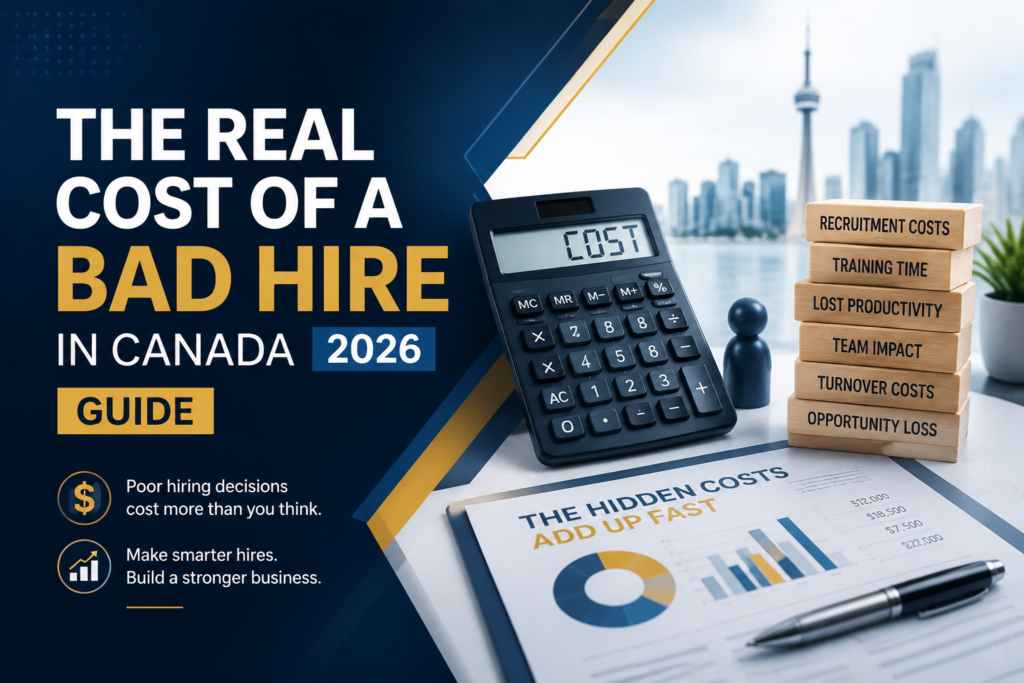
Most Companies Are Underestimating It by 3x — Here Is the Full Picture
⚡ Quick Answer: A bad hire costs Canadian employers between 30% and 150% of that employee’s annual salary, according to the Society for Human Resource Management (SHRM) and Canadian HR research from 2025-2026. For a $60,000/year role, that is a $18,000 to $90,000 loss per wrong hire — including recruitment costs, lost productivity, training investment, team morale damage, client impact, and the cost of replacing the person. Companies that use professional staffing agencies or HR consultants reduce bad hire rates by up to 60%, saving significantly more than the agency fee.
Everyone Talks About Hiring. Nobody Talks About the Bill When It Goes Wrong.
Here is a scenario that is more common than most Canadian business owners want to admit.
You spent six weeks posting the job, reviewing 200 resumes, interviewing 12 candidates, and finally making an offer to someone who seemed perfect on paper. Three months in, the cracks appear. Six months in, you are having uncomfortable conversations. Nine months in, you are starting the process all over again — except now you are also managing the aftermath of a departure, the resentment of a team that carried extra weight, and the clients who noticed the inconsistency.
And the total cost of that one wrong decision? Most business owners look at the recruitment fee and the salary paid during employment and think they have the number. They are almost always wrong by a factor of three.
This guide breaks down exactly what a bad hire actually costs Canadian businesses in 2026 — and more importantly, what you can do to stop it from happening.
What Does a Bad Hire Actually Cost? The Real Numbers for Canadian Employers
The most widely cited figure comes from SHRM: the average cost of a bad hire is 30% of the employee’s first-year salary. But that is the floor — for mid-level and senior roles, the actual cost routinely reaches 100% to 150% of annual compensation. Here is why the number is so much higher than most people expect.
1. Direct Recruitment Costs
These are the costs people actually track — and even here, most businesses undercount:
✔ Job board postings (Indeed, LinkedIn, Glassdoor) — $500 to $3,000 per posting cycle
✔ Internal HR time spent reviewing applications and conducting interviews — typically 40 to 80 hours per hire
✔ Background checks, reference checks, skills assessments — $200 to $800 per candidate
✔ Signing bonuses or relocation packages where applicable
✔ Agency fees if a recruiter was used — typically 15% to 25% of first-year salary
For a $75,000 role, direct recruitment costs alone often reach $8,000 to $15,000 before the person even starts.
2. Onboarding and Training Investment — Lost
Canadian employers spend an average of $2,500 to $8,000 onboarding a new employee when you include orientation time, training materials, management attention, software setup, and the productivity cost of team members pulled into training activities. When the hire does not work out, that entire investment is written off.
For technical, specialized, or client-facing roles — sales, engineering, healthcare, finance — the onboarding investment is significantly higher and the write-off is proportionally more painful.
3. Productivity Loss During the Gap
When a position is vacant or occupied by someone underperforming, productivity loss is the single largest hidden cost. Research from the Canadian HR Reporter estimates:
A vacant mid-level role costs approximately 33% of its annual salary per month in lost output
An underperforming employee in role costs between 25% and 70% of their salary in reduced team output
Managers spend an average of 17% of their time managing performance issues related to poor hires
Team members working around an underperformer report up to 30% reduction in their own engagement scores
4. The Team Damage Nobody Measures
This is the cost that appears nowhere on a spreadsheet and costs the most in the long run. When a bad hire joins a team, the people around them absorb the slack — covering missed deadlines, re-doing poor-quality work, fielding client escalations, and managing interpersonal friction. The result is predictable:
✔ Top performers become disengaged and begin considering other options
✔ Team morale drops, which compounds into lower output across the entire group
✔ Managers burn significant political and emotional capital managing the situation
✔ Some of your best people leave — and replacing them costs you another bad-hire cycle
In a tight Canadian labour market where top talent has options, this cascading effect is genuinely dangerous. One wrong hire, left unaddressed too long, has triggered team departures in companies that had previously strong retention.
5. Client and Reputation Impact
For client-facing roles — account management, sales, customer service, consulting, healthcare — a bad hire does not just affect internal operations. They affect your relationships. In 2026, where online reviews, LinkedIn commentary, and word-of-mouth travel faster than ever, a poor performer in a client-facing role can damage revenue relationships that took years to build.
This cost is almost impossible to fully quantify — but Canadian business owners in professional services and B2B industries consistently identify client relationship damage as the most painful downstream consequence of a wrong hire.
Ready to Hire Right? Let Hyreon Talent Show You How
Bad Hire Cost Calculator — What It Costs at Different Salary Levels in Canada
| Annual Salary | Conservative Estimate (30%) | Mid Estimate (75%) | High Estimate (150%) |
| $45,000 | $13,500 | $33,750 | $67,500 |
| $60,000 | $18,000 | $45,000 | $90,000 |
| $80,000 | $24,000 | $60,000 | $120,000 |
| $100,000 | $30,000 | $75,000 | $150,000 |
| $150,000 (Executive) | $45,000 | $112,500 | $225,000 |
Note: High estimates apply to senior, specialized, client-facing, and executive roles where productivity impact and replacement costs are greatest.
Why Do Bad Hires Happen? The Honest Reasons Canadian Employers Keep Getting It Wrong
Understanding why bad hires happen is the first step to preventing them. In our experience working with Canadian businesses across multiple industries, the causes are almost always one or more of the following:
Hiring Under Pressure
The most common cause. A position is vacant, workload is piling up, and the urgency to fill the role overrides the discipline to fill it right. Hiring managers shortcut the process — skipping reference checks, compressing interviews, or making an offer to the best available candidate rather than waiting for the right one.
Vague Job Descriptions That Attract the Wrong People
A job description that describes tasks without defining outcomes, culture fit, or realistic expectations will attract candidates who look good on paper and struggle in reality. In 2026, with AI-assisted resume writing making every application look more polished than it used to, the gap between a strong application and a strong employee is wider than ever.
Interviewing for the Wrong Things
Traditional interviews — tell me about yourself, what are your strengths and weaknesses — are remarkably poor predictors of job performance. Structured behavioural interviewing, skills-based assessments, and cultural fit evaluation require expertise that most internal hiring managers are not trained in and do not have time to apply consistently.
No Structured Onboarding
Even good hires fail when onboarding is disorganized. A new employee without clear expectations, proper resources, and a structured first 90 days will underperform relative to their actual capability — and many never recover that lost momentum.
Relying Entirely on Internal Hiring
Internal hiring managers have limited candidate pools, limited recruitment expertise, and a full-time job that is not recruitment. The result is a hiring process that takes longer, produces fewer qualified candidates, and makes decisions with less information than a professional recruiter would bring to the same role.
How to Stop Making Bad Hires — What Actually Works in 2026
The good news is that bad hires are largely preventable. The companies with the lowest bad-hire rates in Canada share a consistent set of practices:
1. Define the Role Before You Post It
Before writing a single word of a job description, define what success looks like in the role at 30, 60, and 90 days. What decisions will this person make? What relationships will they own? What does a top performer in this role do differently from an average one? Build your job description, your interview questions, and your evaluation criteria around those answers.
2. Use Structured, Behavioural Interviews
Structured interviews — where every candidate is asked the same questions in the same order — combined with behavioural questioning (tell me about a time when…) are significantly better predictors of job performance than unstructured conversations. Add a practical skills component where relevant and your selection accuracy improves dramatically.
3. Check References Properly
Most reference checks are perfunctory. A properly conducted reference check goes beyond confirmation of employment dates — it probes for specific performance patterns, management style feedback, and candid assessment of the candidate’s fit for your specific role. Done well, reference checks surface critical information that interviews miss.
4. Work With a Professional Recruitment Partner
This is where the math becomes straightforward. A professional staffing agency or recruitment firm brings:
✔ Access to passive candidates who are not actively applying to job boards
✔ Pre-screened, pre-qualified shortlists that reduce your time-to-hire by 40% to 60%
✔ Market intelligence on compensation benchmarks and candidate availability
✔ Structured evaluation frameworks developed across hundreds of similar hires
✔ Replacement guarantees that protect your investment if a placed candidate does not work out
When you compare the agency fee — typically 15% to 25% of first-year salary — against the cost of a bad hire (30% to 150% of salary), the math is not even close. A good recruitment partner pays for itself on the first hire.
People Also Ask — Canadian Employer Hiring FAQs (2026)
Q: How much does it cost to replace an employee in Canada?
Replacing an employee in Canada costs between 50% and 200% of their annual salary when you account for recruitment costs, lost productivity during vacancy, onboarding investment for the replacement, and the impact on team performance during transition. For a $70,000 role, total replacement cost typically runs between $35,000 and $140,000.
Q: How do staffing agencies in Canada reduce bad hire risk?
Professional staffing agencies reduce bad hire risk through candidate pre-screening, behavioural assessments, structured reference checking, and access to a broader candidate pool including passive candidates. Most agencies also offer replacement guarantees — if the placed candidate does not work out within a defined period, they replace them at no additional cost.
Q: What industries in Canada have the highest bad hire rates?
Industries with the highest bad hire rates in Canada include retail, hospitality, construction, and early-stage technology companies — typically because of rapid hiring cycles and limited HR infrastructure. Professional services, healthcare, and financial services have lower bad hire rates but the highest cost per bad hire due to higher salary levels and greater client relationship exposure.
Q: How long does it take to recognize a bad hire?
Most managers identify a bad hire within 3 to 6 months — but the average time before action is taken is 9 months. This gap between recognition and action is where most of the cost accumulates. Companies with clear 30-60-90 day onboarding milestones and structured performance check-ins identify underperformance earlier and reduce total bad hire cost significantly.
Q: Is it worth using an executive search firm for senior roles in Canada?
For roles above $100,000 in annual compensation, using an executive search firm is almost always cost-justified. The cost of a bad hire at executive level typically exceeds $150,000 to $300,000 when you include leadership disruption, strategic delays, and team impact. A professional executive search firm reduces that risk while accessing candidates who are not visible through job boards.
The Bottom Line: The Most Expensive Thing You Can Do Is Hire Wrong
In 2026, Canadian businesses are operating in a labour market that rewards precision. The candidates you want are employed, selective, and comparing multiple opportunities. The cost of getting it wrong — financially, culturally, operationally — has never been higher.
The companies winning the talent game are not the ones working harder at hiring. They are the ones hiring smarter — with better processes, better tools, and better partners.
At Hyreon Talent, we work with Canadian businesses across staffing, HR consulting, talent management, and executive search to build hiring processes that get it right the first time. We have seen what bad hires cost organizations firsthand — and we have helped hundreds of Canadian employers avoid that cost entirely.
Your next hire is either your biggest risk or your best investment. The difference is the process behind it.
Ready to Hire Right? Let Hyreon Talent Show You How.
Staffing · HR Consulting · Executive Search · Talent Management
hyreontalent.com | Serving Canadian businesses nationwide | Free initial consultation