
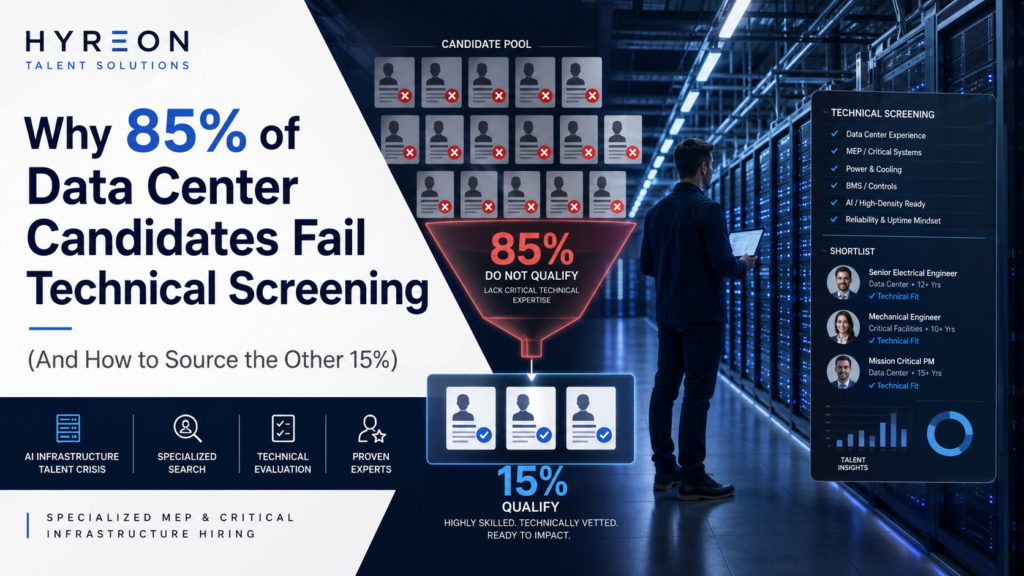
| QUICK ANSWER Roughly 85% of applicants for data center and critical infrastructure roles fail technical screening because ATS keyword matching cannot distinguish genuine MEP (mechanical, electrical, plumbing) expertise from resume vocabulary. Terms like “UPS,” “chiller,” or “commissioning” pass the filter whether the candidate designed a 100MW cooling system or merely walked past one. The other 15% — proven, deployment-ready infrastructure talent — are overwhelmingly passive candidates who never apply through job boards. Sourcing them requires proactive talent mapping and technical-first headhunting, not more applicant volume. |
The AI boom has a bottleneck, and it isn’t chips or capital. It’s people. Hyperscalers and colocation providers across North America have committed hundreds of billions of dollars to new data center capacity through 2030 — yet builds are slipping quarter after quarter because the industry cannot staff them. If you’re a VP of Infrastructure, an HR Director, or an Engineering Lead who has watched a Lead MEP Engineer requisition sit open for five months while 400 “qualified” applicants failed your technical screen, this article explains exactly why that’s happening — and what the companies that are hitting their hiring targets do differently.
How Bad Is the AI Infrastructure Talent Shortage in 2026?
The numbers describe a workforce crisis hiding inside a capital boom:
- Demand is outrunning supply. The Uptime Institute has projected the global data center workforce must grow to roughly 2.3 million by 2025–2026, while more than half of operators already report difficulty finding qualified candidates.
- The talent pool is aging out. A significant share of the senior MEP and facilities engineering workforce is within a decade of retirement, taking decades of commissioning and live-environment experience with them.
- AI has changed the job itself. A single AI-ready hyperscale campus can require hundreds of specialized engineers and technicians across electrical, mechanical, controls, and commissioning — roles that barely existed at this scale five years ago.
- Vacancy costs are enormous. Every month a critical role stays open, construction milestones slip. On a hyperscale build, a delayed energization date can cost millions in idle capital and missed customer commitments.
Funding is not the constraint anymore. The constraint is the 15% of candidates who can actually do the work — and the fact that your current hiring process is optimized to find the other 85%.
Why Do 85% of Data Center Candidates Fail Technical Screening?
When infrastructure leaders audit their failed hires and rejected pipelines, the same four failure patterns appear almost every time:
1. ATS Keyword Matching Can’t Read Depth
Applicant tracking systems screen for vocabulary, not competence. A candidate who spent three years changing filters near a chiller plant and a candidate who designed the N+1 cooling architecture for a 48MW facility can produce nearly identical keyword profiles: “chillers, CRAH units, HVAC, preventive maintenance, data center operations.” The ATS scores them the same. Your engineering panel discovers the difference in hour one of the interview — after your team has already burned weeks of screening time.
2. Adjacent Experience Gets Mistaken for Core Experience
Commercial HVAC, light industrial electrical, and general facilities backgrounds flood every data center posting. These are real skills — but a mission-critical environment with 99.999% uptime obligations, live electrical work protocols, EPMS/BMS integration, and change-management discipline is a different profession. Keyword filters cannot make that distinction. Recruiters without domain training can’t either.
3. The Best Candidates Never Enter the Funnel
This is the uncomfortable math: the deployment-ready 15% are almost all employed, counter-offered, and off-market. They don’t browse job boards. Data center operators poach them from each other through relationships, not postings. If your entire pipeline comes from inbound applications, you are — by definition — screening the population that the rest of the industry didn’t retain.
4. Job Descriptions Are Written for the Wrong Filter
Most infrastructure JDs are a copy-paste of certifications and acronyms, which invites keyword-stuffed resumes and repels the pragmatic senior engineers who self-select out of buzzword-heavy postings. The result is a funnel that maximizes volume and minimizes signal — the exact opposite of what a critical infrastructure hire requires.
Traditional Recruiting vs. Specialized Infrastructure Search: What’s the Difference?
| Factor | Traditional ATS / Job Board Approach | Specialized Infrastructure Search |
| Candidate source | Inbound applicants (active job seekers) | Mapped passive talent across North America |
| Screening method | Keyword matching, generalist phone screens | Technical vetting by domain specialists |
| Typical pass rate to final interview | ~10–15% of shortlisted candidates | 70%+ of presented candidates |
| Time-to-hire (senior MEP roles) | 4–7 months, often re-opened | 30–45 days |
| Hidden cost | Engineering hours lost to failed screens; project delays | Search fee — recovered in weeks of saved schedule |
How Do You Actually Source the Other 15%?
The organizations consistently filling Lead MEP Engineer, Commissioning Manager, and Critical Facilities Director roles in this market follow a fundamentally different playbook:
- Map the market first. Before any outreach, build a map of who actually holds your target role today — by operator, by region, by facility class. In critical infrastructure, the qualified universe for a senior role is often only 100–300 people across North America. Treat it like account-based sales, not advertising.
- Put technical fluency at the front of the funnel. The first screening conversation should be led by someone who can discuss single-line diagrams, concurrent maintainability, and commissioning levels credibly. Senior engineers disengage instantly when screened by someone reading keywords off a sheet.
- Sell the project, not the vacancy. Passive candidates don’t move for postings — they move for projects. Lead with the build: megawattage, design topology, technology stack, growth path. The role sells the opportunity; the JD is paperwork.
- Vet against scenarios, not checklists. Verify claimed experience against real scenarios: walk through a failure event they managed, a commissioning phase they owned, a live-environment change they executed. Scenario depth exposes resume inflation in minutes.
- Move at market speed. The 15% receive counter-offers almost universally. Compress the process — one technical deep-dive, one leadership conversation, decision within days. Every added week returns candidates to their current employer’s retention machine.
| Stop Screening the 85%. Start Interviewing the 15%. Hyreon Talent maps and headhunts passive, pre-vetted critical infrastructure talent across North America — MEP engineering, commissioning, controls, and data center operations leadership. Let us deliver your next Lead MEP Engineer in under 30 days → hyreontalent.com |
Which Roles Are Hardest to Fill Right Now?
Across current North American data center and AI infrastructure builds, these are the searches where the 85% problem bites hardest:
| Role | Why It’s Critical | Market Reality (2026) |
| Lead MEP Engineer | Owns mechanical/electrical design integrity across the build | Deep scarcity; nearly all qualified candidates passive |
| Commissioning Manager (Cx) | Gatekeeper between construction and revenue-generating operation | Poached aggressively between operators |
| Critical Facilities / Site Director | Accountable for uptime SLAs and site P&L | Long searches; failed hires extremely costly |
| Controls / BMS-EPMS Engineer | Integrates monitoring across power and cooling systems | Tiny talent pool; competes with automation sector |
| Electrical Superintendent (Mission-Critical) | Live-environment electrical safety and execution | Trades shortage compounds the gap |
If any of these titles has been open on your careers page for more than 60 days, the posting is not going to fill it. The market for these professionals operates on direct approach — which is precisely why specialized search exists.
Frequently Asked Questions
Why can’t our ATS screen data center candidates accurately?
ATS platforms match keywords, not competence. MEP and critical infrastructure vocabulary appears on thousands of adjacent-industry resumes, so keyword filters pass candidates who have exposure to the terms but not ownership of the systems. Accurate screening requires domain-fluent technical conversations, which generalist processes can’t provide at the top of the funnel.
What does the ‘85% failure rate’ actually refer to?
Across the industry, infrastructure hiring teams consistently report that the overwhelming majority of applicants who pass resume screening for specialized data center roles — commonly cited around 85% — are eliminated at the technical interview stage. The failure isn’t the candidates; it’s a funnel design that selects for keyword density instead of demonstrated capability.
How long should it take to hire a Lead MEP Engineer?
Through job boards, senior MEP searches in this market routinely run 4–7 months and are frequently re-opened after failed offers. A specialized search built on existing talent maps and pre-vetted passive candidates typically presents a qualified shortlist in 2–3 weeks and closes in 30–45 days.
Is the data center talent shortage going to improve?
Not in the near term. AI-driven capacity commitments keep expanding while the experienced workforce ages toward retirement faster than new specialists are being developed. Analysts across the industry expect the gap to widen through the late 2020s — which means sourcing strategy, not patience, is the lever hiring leaders control.
What’s the real cost of a data center role staying vacant?
For roles tied to construction and commissioning milestones, vacancy costs compound: delayed energization, idle capital, contractual penalties, and burnout attrition among the engineers covering the gap. On hyperscale projects, a single delayed quarter can dwarf a decade of recruitment fees.
How is a specialized infrastructure search firm different from a staffing agency?
Staffing agencies redistribute active applicants — the same 85% every operator is already screening. A specialized search partner maintains living maps of who holds critical roles across the market, approaches passive talent directly, and technically vets candidates before you ever see a resume. You interview the 15%, exclusively.
| Your Next Critical Hire Is Already Employed. We Know Where. Stop wasting months screening unqualified applicants. Hyreon Talent delivers pre-vetted MEP, commissioning, and data center leadership candidates across North America — with technical screening done before the first interview. Book a Confidential Search Consultation → hyreontalent.com |