

HYREON Talent Solutions • Market Intelligence • Canada
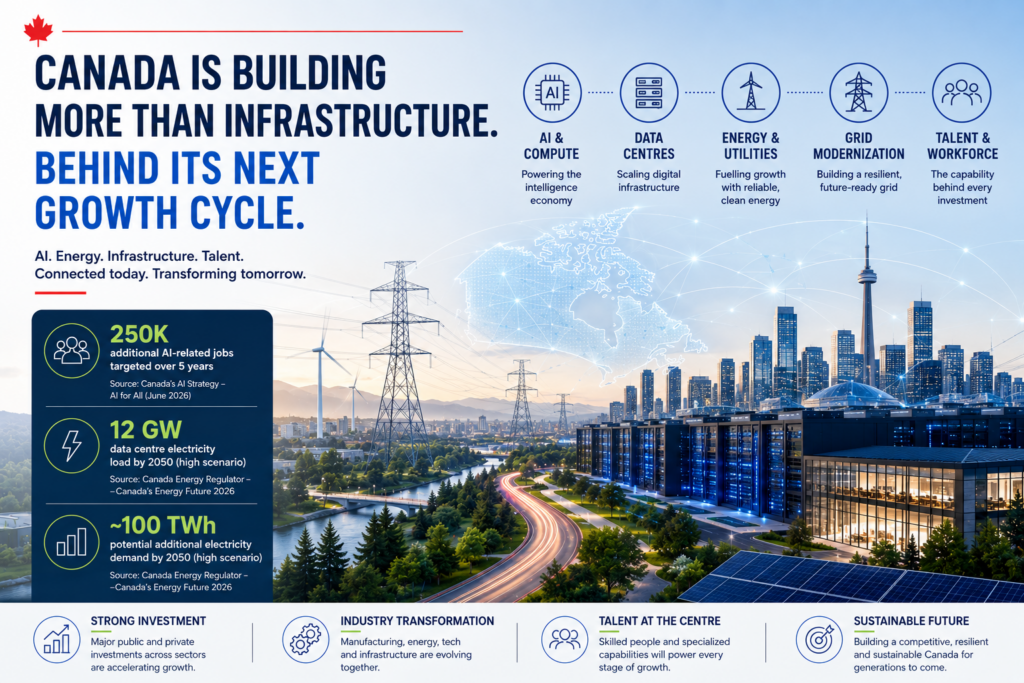
Canada’s next major growth cycle may not be defined by a single industry. It may be defined by the infrastructure connecting several industries together.
Artificial intelligence is accelerating demand for computing capacity. Computing capacity requires data centres. Data centres require power, connectivity, cooling systems, and physical infrastructure. Power demand creates pressure for generation, transmission, distribution and ultimately on the grid. Grid modernization and energy storage will be critical to strengthening grid resilience, managing rising demand and enabling reliable power for this growing infrastructure. Infrastructure investment creates demand for engineering, construction, manufacturing, supply chains, operations and maintenance.
And behind every one of these systems is the same fundamental requirement: People with the right capabilities, in the right place, at the right time.This is why Canada’s emerging AI and infrastructure story deserves to be viewed as more than a technology story.It is becoming an energy story, an infrastructure story, a community involvement story and, increasingly, a talent story.
For organizations planning investments in Canada over the next five years, that intersection may be one of the most important market dynamics to watch.
AI Is Becoming an Infrastructure Story
Canada’s national artificial intelligence strategy, AI for All, is explicitly positioning AI as an economic and infrastructure priority.
The federal strategy aims to help create up to 250,000 new jobs through AI adoption by 2031, while separately supporting up to 90,000 AI-related jobs and work-placement opportunities for young Canadians. It also targets an increase in Canadian business AI adoption from approximately 12% today to 60% by 2034. But the most important part of the strategy for infrastructure leaders may be what sits underneath those targets.
Canada is seeking to strengthen its sovereign AI foundation through:
- Large-scale computing infrastructure
- Domestic data-centre capacity
- Cloud infrastructure
- High-capacity connectivity
- Secure digital systems
- AI research infrastructure
- Advanced semiconductor and photonics capabilities
- A larger domestic AI talent pool
The strategy notes that Canada may require approximately 5.5 GW of AI compute for commercial players by 2030, while proposed public-private initiatives could provide 850 MW of compute capacity by 2030, with potential scaling to 2.3 GW. That changes the nature of the conversation. AI does not operate in the cloud in a physical sense, it operates through physical infrastructure and that infrastructure has to be designed, financed, permitted, constructed, powered, connected, operated and maintained.
The physical layer behind Canada’s AI ambitions
A large-scale AI ecosystem requires much more than GPUs. It requires: Compute → Data Centres → Power → Grid → Connectivity → Engineering → Construction → Manufacturing → Operations → Talent
Each layer creates dependencies for the next:
- A shortage in electrical engineering can affect project delivery.
- A shortage of skilled trades can affect construction schedules.
- A shortage of commissioning specialists can delay operational readiness.
- A shortage of experienced project leaders can increase execution risk.
- A shortage of specialized technicians can become an operational problem long after the construction phase is complete.
This is why workforce planning needs to begin alongside infrastructure planning not after the project is already underway.
The AI Economy Needs an Energy Economy Behind It
If AI is the demand driver, electricity is one of the critical enabling systems. Canada’s Energy Future 2026 from the Canada Energy Regulator provides an important illustration of how significant this relationship could become.
In the Higher Scenario, the CER assumes Canada’s data-centre load could reach 12 GW by 2050. Data-centre load growth represents approximately 100 TWh, or about one-third of projected end-use electricity-demand growth in that scenario. That figure is a scenario rather than a prediction, and the distinction matters. The CER models multiple possible futures rather than presenting one guaranteed outcome.
But the direction of the analysis is significant: Data centres are becoming an increasingly important variable in Canada’s electricity planning.
The relationship is straightforward: More AI adoption → More compute → More data-centre capacity → More electricity demand → More infrastructure requirements
Those requirements can extend across:
- Power generation
- Transmission
- Distribution
- Substations
- Grid control systems
- Electrical engineering
- Energy management
- Construction
- Equipment manufacturing
- Maintenance
- Project management
The AI conversation therefore increasingly intersects with Canada’s energy and infrastructure conversation.
Canada’s Electricity System Will Need to Scale With the Economy
The CER’s 2026 outlook shows that electricity demand increases across its scenarios, although the scale varies considerably. In its Higher Scenario, end-use electricity demand increases by 73% between 2023 and 2050, while electricity capacity rises from approximately 160 GW in 2023 to 360 GW by 2050.
In the Canada Net-Zero scenario, electricity demand increases even more sharply, with end-use electricity demand rising 84% by 2050 and electricity capacity reaching approximately 400 GW. The implications extend beyond generation.An electricity system operating at significantly larger scale requires: Generation + Transmission + Distribution + Grid Control + Engineering + Construction + Manufacturing + Maintenance
That means Canada’s energy transition and infrastructure expansion are also workforce-development challenges. Natural Resources Canada has specifically identified shortages of skilled workers needed for the electricity buildout and manufacturing ramp-up, including specialized capabilities related to high-voltage transmission, substation construction, turbine installation and grid-control systems.
For businesses operating in these markets, the question therefore becomes: Where will the people required to build and operate this infrastructure come from?
Data-Centre Growth Now Depends on How It Is Built, Not Just Whether It Is Built
There is a second conversation happening alongside the growth conversation. It is happening in municipal council chambers, in community consultations and, increasingly, in provincial policy. As data centre proposals have multiplied, communities have raised legitimate questions about electricity consumption, water use, noise, land use and whether the promised local economic benefit is real.
Those questions are not obstacles to growth. They are part of it. A project that cannot secure community support and grid access cannot be built regardless of how strong the business case looks on paper.
The scale explains the scrutiny. Ontario’s Ministry of Energy and Mines has indicated that data centre connection applications in the provincial pipeline could exceed 10,000 MW roughly 40% of the province’s recent peak electricity demand. Several Ontario municipalities have responded with temporary moratoria while they study the impacts.
The encouraging development is that practical solutions already exist and provincial policy is beginning to promote them.
Ontario’s draft Data Centre Playbook, released in August 2026, sets out a framework anchored in three principles: that data centres invest substantially in Ontario and in local communities, that they pay the full cost of their electricity use and connection-related infrastructure, and that provincial support will be non-financial rather than subsidy-based.
Other provinces are moving in parallel. Alberta’s system operator has capped near-term large-load connections and directed developers outside that queue to supply their own generation. British Columbia has restricted high-load grid connections and requires developers to demonstrate clear local economic benefit, including meaningful Indigenous partnership.
The direction is consistent: growth is welcome, but it has to be built responsibly — and it has to bring the community with it.
Here is what that can look like in practice.
Bring your own power
The most direct solution to grid strain is not to create it. “Bring your own power” on-site or behind-the-meter generation allows a facility to supply some or all of its own load rather than drawing it from the public system.
Ontario’s draft framework signals that proponents who develop their own generation, and thereby reduce what they draw from the provincial grid, may be viewed more favourably in the connection process. The effect is significant. Instead of competing with households and existing industry for finite capacity, a project arrives with new supply attached to it.
That creates demand for a specific set of capabilities: power development, generation engineering, interconnection, permitting, EPC delivery, plant operations and asset management.
Storage and flexibility to manage peak demand
The second solution is not to remove demand, but to move it. Battery energy storage charges during off-peak hours and discharges when the system is under pressure, reducing the peak that new generation and transmission would otherwise have to be built to serve.
Ontario has already procured close to 3 GW of storage through successive IESO procurements, and storage has become a central part of how the province plans for peak conditions. Flexible load can achieve the same result from the demand side, shifting non-urgent computing workloads, curtailing at system peaks or switching to on-site generation during the highest-demand hours.
The result is a growing sector in its own right: Storage Developers → Microgrid Operators → Demand-Response Providers → Grid-Flexibility Platforms → Energy-Management Specialists
Each of these is also a hiring market.
Site the project near the energy, not near the neighbourhood
Location decisions can resolve several concerns at once. Siting facilities close to generation, along transmission corridors, on industrial or brownfield land and at a meaningful distance from residential areas reduces transmission requirements, limits noise and visual impact, and lowers the likelihood of land-use conflict.
Cooling technology matters here as well. Ontario has indicated it would prioritize facilities using closed-loop cooling systems, which consume virtually no water in operation, addressing one of the most frequently raised community concerns directly.
Good siting is not only an environmental decision. It is a permitting decision, a cost decision and as the sections that follow explain a workforce decision.
Involve the community as a participant, not an audience
Consultation that begins after the permit application is not consultation. The stronger model brings communities in early and gives them a genuine stake in the outcome:
- Early and continuous engagement with municipalities and residents
- Indigenous participation, including equity partnership rather than accommodation alone
- Community benefit agreements tied to measurable local outcomes
- Local hiring commitments with published targets
- Transparent reporting on noise, water and environmental performance
There is precedent for this in Canada’s energy sector. Ontario’s 250 MW Oneida storage facility is located on land owned by Six Nations of the Grand River, and most of the projects selected in the province’s first expedited storage procurement carried significant Indigenous economic participation. The principle is straightforward: communities tend to support projects they have a stake in.
Build the local workforce before the project needs it
Local hiring commitments only work if local people hold the qualifications.
That means training has to begin well before commissioning:
- Partnerships with colleges, polytechnics and technical institutes
- Apprenticeship sponsorship across the electrical, mechanical and construction trades
- Co-op and internship placements during the construction phase
- Operator and technician training designed around the facility’s actual systems
- Scholarships and bursaries linked to the occupations the project will genuinely need
- Upskilling pathways for workers transitioning from other industrial sectors
This is also where provincial policy could have meaningful leverage. Curriculum alignment, apprenticeship incentives and funded training partnerships can turn a single project into regional capability that outlasts it.
A project that trains its own workforce is not simply filling roles.
It is creating a regional talent supply that reduces execution risk for every project that follows.
Make a non-urban location workable for the workforce
If projects are deliberately sited away from residential areas and closer to energy sources, the workforce still has to be able to get there. That is a solvable problem but only when it is treated as part of the employment offer rather than as the candidate’s problem:
- Travel allowances, mileage reimbursement or transit subsidies
- Employer-provided shuttle or vanpool arrangements from nearby population centres
- Compressed work weeks or rotational schedules that reduce commuting frequency
- Remote or hybrid arrangements for roles that do not require site presence
- Relocation support, housing allowances or temporary accommodation during construction phases
- On-site amenities and EV charging for commuting staff
For senior and specialized roles in particular, these provisions can be the difference between a strong candidate accepting and declining.
Location fit is not a fixed constraint. It is a design decision.
Why this belongs in a workforce conversation
Every solution described above is delivered by people.
Bring Your Own Power → Storage & Flexibility → Responsible Siting → Community Partnership → Local Training → Workforce Access
On-site generation requires power engineers, project developers and plant operators. Storage and flexibility require controls, automation and energy-management specialists. Responsible siting requires environmental, permitting and stakeholder-relations professionals. Community partnership requires Indigenous relations and community-engagement capability.
Local training requires technical training, apprenticeship management and workforce-development expertise. Workforce access requires mobility planning, compensation design and recruitment strategy built around geography. The environmental and community solutions are therefore not separate from the talent conversation.
They are becoming one of the largest drivers of it.
The ecosystem around a major infrastructure project
A major infrastructure project depends on a broad ecosystem of talent working across engineering, project delivery, construction, technology, safety, operations and leadership.
The workforce can include technical specialists, engineers, project and construction professionals, skilled trades, procurement and supply-chain teams, commissioning experts, technology specialists, and operations and maintenance professionals.
The exact talent requirements vary by project, scale and stage of development. What remains consistent is the need for the right expertise at the right time to support successful project delivery and long-term operations.
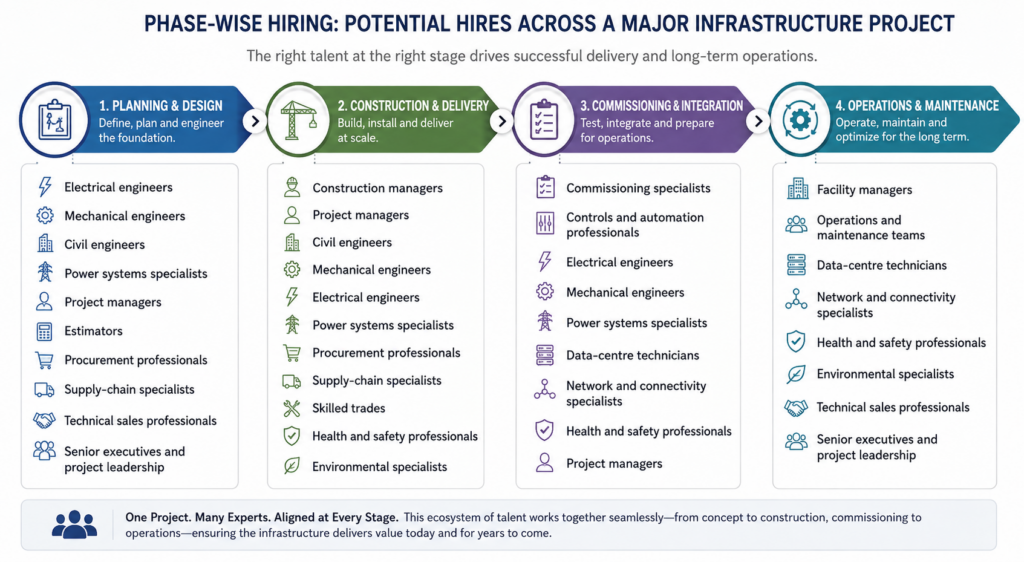
This is where the traditional definition of an infrastructure workforce begins to change. The workforce is no longer a single hiring category. It becomes an interconnected talent ecosystem.
Advanced Manufacturing Is Part of the Same Growth Story
The infrastructure required for AI and electrification does not exist independently of manufacturing.
Data centres require electrical equipment, cooling systems, networking infrastructure and other specialized components. Grid modernization requires transformers, switchgear, control systems, transmission equipment and other infrastructure.
Energy projects require equipment, engineering services, construction capabilities and ongoing maintenance. That creates a second-order effect: Infrastructure investment can generate industrial demand beyond the original project.
Canada’s federal government has also recently identified advanced manufacturing, energy and electricity, mining and minerals, transportation and supply chains, and housing and construction among sectors requiring coordinated workforce strategies. The Advanced Manufacturing Workforce Alliance, announced in August 2026, is designed specifically to align workforce strategies with employer and training needs in critical sectors.
The larger story is therefore becoming clearer. Canada is not simply building individual projects. It is building capacity across connected sectors.
The Biggest Constraint May Not Be Capital. It May Be Capability.
Natural Resources Canada similarly identifies workforce shortages as a potential constraint on Canada’s electricity buildout, warning that insufficient workforce development could contribute to project bottlenecks, cost overruns and development delays. This is a critical consideration for companies planning large projects.
The question is no longer simply:“Can we finance the project?”
It is also:“Can we assemble the workforce required to execute it?”
And more importantly: “Can we assemble that workforce in the location where the project actually needs it?”
Location Will Matter as Much as Qualification
One of the most underestimated aspects of infrastructure recruitment is geography. A candidate can have the right technical qualification and still be the wrong hire for a project if they cannot realistically work at the project location. Infrastructure projects are not always located in major urban centres.
They may be located:
- Outside major cities
- Near industrial corridors
- Close to power-generation facilities
- Along transmission routes
- In regional communities
- Near resource-development areas
- On large industrial sites
- In emerging technology clusters
That creates a different recruitment challenge from conventional corporate hiring.
The question becomes: Can the talent actually reach the project, stay there and remain productive over the required project lifecycle?
This is where workforce strategy becomes much more important than simply publishing a job description.
Local Workforce Capacity Can Become a Competitive Advantage
Large infrastructure projects ultimately become part of the communities in which they are built. That means workforce planning cannot always be separated from regional workforce development.
Local hiring pathways, apprenticeship relationships, partnerships with colleges and technical institutions, Indigenous participation, targeted regional recruitment and early operator training can all become important components of a long-term workforce strategy.
The objective is not simply to fill vacancies.It is to create a pipeline.
From project hiring to workforce pipeline
A stronger model can look like: Project Forecast → Workforce Mapping → Skills Gap Analysis → Regional Talent Mapping → Candidate Pipeline → Hiring → Training → Deployment → Retention
This is fundamentally different from waiting until a vacancy appears. If a project requires 100 specialized workers six months from now, discovering the shortage five months from now is already a workforce problem.
The better question is: What will the project need 6, 12, 24 and 36 months from now — and where will those capabilities come from?
That is workforce planning.
Where HYREON Talent Solutions Fits Into This Market
This is where HYREON’s role becomes particularly relevant.
HYREON Talent Solutions sits at the intersection of: Market Intelligence × Talent Strategy × Recruitment
The value is not simply in finding someone who matches a job description.It is in understanding the capability the organization actually needs, the market in which that capability exists and the recruitment strategy required to access it.
For infrastructure-intensive organizations, that can mean helping answer questions such as:
- What roles will be required as the project scales?
- Which skills are likely to be difficult to source?
- Which talent markets should the organization target?
- Should the company hire locally, nationally or internationally?
- Which roles require immediate recruitment?
- Which roles can be developed through training?
- Which positions require project-specific experience?
- Where are experienced technical professionals concentrated?
- What leadership capabilities will be required as the operation expands?
- How can the organization build a talent pipeline before project commissioning?
- How can recruitment support both immediate delivery and long-term workforce stability?
That changes recruitment from a reactive activity into a strategic business function.
HYREON’s Approach: The Right Talent, in the Right Place, at the Right Time
For companies entering or expanding within Canada’s infrastructure, energy, utilities, manufacturing or technology markets, a practical talent strategy can be built around four stages.
Talent strategies should also account for applicable federal and provincial employment laws, as requirements can vary depending on the jurisdiction and nature of the work.
Access the Right Talent Market
Once the capability requirement is clear, recruitment can become much more targeted.
The relevant candidate market may include:
- Local professionals
- Regional talent
- National candidates
- Relocating professionals
- Specialized technical talent
- Project-based specialists
- Experienced leadership
- Emerging professionals
- Candidates with transferable industry experience
The objective is not to generate the largest number of applications. It is to identify the most relevant talent pool.
Build Beyond the Immediate Hire
The strongest recruitment strategy does not end when the position is filled.
Organizations should also consider: Succession → Retention → Skills Development → Workforce Expansion → Future Leadership
A project that requires 50 employees today may require 200 tomorrow. A facility that needs commissioning specialists today may need a permanent operations team later. A new business unit may eventually need regional leadership.
Talent strategy must therefore evolve with the asset.
What Canada’s Next Growth Cycle Could Look Like
If the current direction continues, Canada’s growth story may increasingly resemble an interconnected system rather than a collection of separate industries.
What Business Leaders Should Be Asking Now
For executives planning investment, expansion or workforce growth in Canada, several questions deserve attention now rather than later.
- What capabilities will our organization require over the next three to five years?
- Which roles are critical-path positions?
- What happens if a key position remains vacant for three months?
- Is recruitment being treated as an operational cost or as part of project strategy?
These questions can reveal workforce risks before they become project risks.
The HYREON Perspective
At HYREON Talent Solutions, we look at the market through a simple relationship:
Market Movement → Industry Growth → Capability Demand → Specialized Talent
The purpose is not to claim that every market signal will become a guaranteed outcome. It is to identify emerging patterns early enough for organizations to make better workforce decisions.
For companies operating across Canada’s infrastructure, energy, utilities, data centre, manufacturing and technology ecosystems, that means thinking about recruitment before the vacancy exists.
It means :
- Understanding the project.
- Understanding the location.
- Understanding the capability.
- Understanding the talent market.
- And then connecting the organization with people who can actually deliver the work.
The goal is not simply to find a candidate.
The goal is to help organizations find the right capability, in the right market, at the right time and build the workforce required for what comes next.
Partner With HYREON Talent Solutions
If your organization is planning expansion, infrastructure development, data centre operations, energy projects, advanced manufacturing or other growth initiatives in Canada, the workforce strategy should start before the hiring deadline.
HYREON Talent Solutions helps organizations connect market intelligence with talent strategy and specialized recruitment helping identify the capabilities required, understand the talent market and build targeted recruitment pipelines.
Whether you need specialized technical professionals, skilled project leadership, engineering capability, operations talent or critical business functions, the objective is the same: Right Talent. Right Place. Right Time.
Talk to HYREON Talent Solutions about your next workforce requirement.
Market Intelligence × Talent Strategy × Recruitment